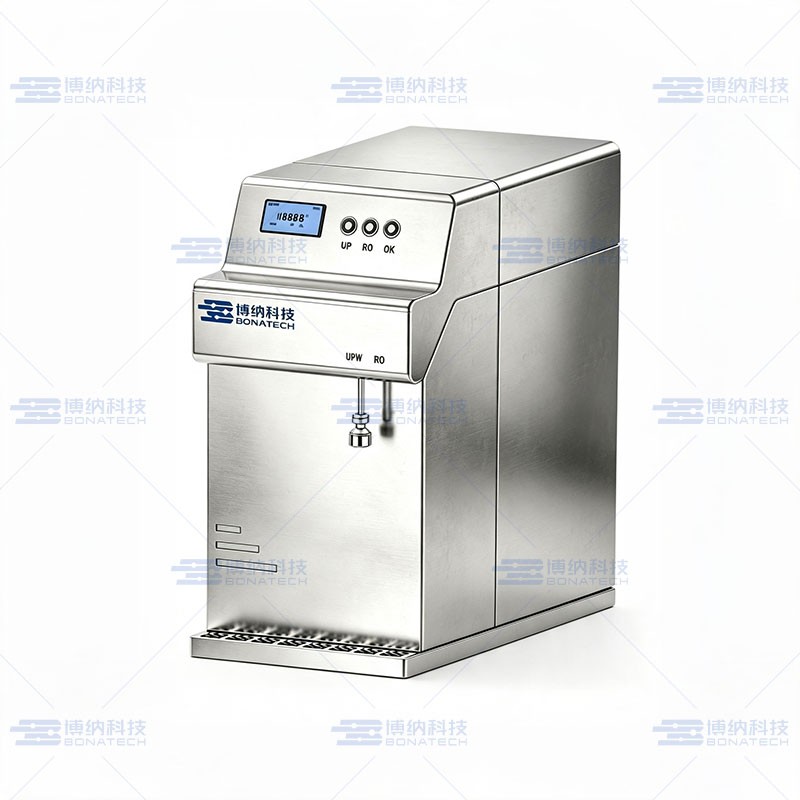
Fully Automated Cycle Control
The system adopts fully automated control with a complete "Standby — Rinse — Produce — Standby" automatic cycle program. Upon startup, it automatically performs pretreatment regeneration / rinsing and RO membrane low-pressure start-up flush. If product water quality is out of specification, it enters recirculation mode; once water quality meets the standard, it automatically draws water — the entire process requires no manual intervention.
RO / UP Dual Independent Outlets
The system is equipped with two independent outlets for RO water (purified water) and UP water (ultrapure water); the two streams are produced independently without mutual interference. The RO and UP outlets are fitted with independent control valves, and the UP outlet features water quality monitoring display. Users can draw water of different purity grades according to experimental needs, avoiding cross-contamination and enabling multi-purpose operation with one unit. The RO and UP product water specifications collectively comply with the relevant grade requirements of CLSI, ASTM D1193 and the Chinese Pharmacopoeia.
RO Purified Water
Grade 2 Laboratory Purified Water
Used for routine reagent preparation, buffer dilution and glassware rinsing; controlled by an independent on/off valve.
RO PRODUCTIVITY · Reverse Osmosis Product Water Specs
-
Rated Production Rate 30 L/h
-
Instant Draw When Tank Is Full 1.5 ~ 2 L/min
-
Ion Rejection Rate 96 % ~ 99 %
-
Control Method Fully Automated
-
Bacteria Removal Rate > 99.9 %
UP Ultrapure Water
Grade 1 Laboratory Ultrapure Water
Used for trace analysis, HPLC, PCR, cell culture and molecular biology; features water quality monitoring display.
UP PRODUCTIVITY · Ultrapure Water Specs
-
Ultrapure Water Resistivity 18.25 MΩ·cm@ 25°C
-
Heavy Metal Ions < 0.01 ppb
-
Total Organic Carbon (TOC) < 3 ppb
-
Bacteria (After Terminal Filtration) < 1 cfu/mL
-
Particles > 0.1 μm < 1 / mL
-
Endotoxin (Pyrogen) < 0.001 EU/mL
-
RNase (Ribonuclease) < 1 pg/mL
-
DNase (Deoxyribonuclease) < 5 pg/mL
Cartridge Housing Food-Grade Safety
The cartridge housing is made of high-purity PP material and complies with the GB 4806.7—2023 food contact materials safety standard; indicators such as total migration and heavy metals meet requirements stricter than national standard limits. A third-party test report is provided together with delivery.
MATERIAL · Material
High-Purity PP
Dimensionally stable, pressure- and temperature-resistant.
STANDARD · Standard
GB 4806.7—2023
National food contact materials safety standard.
MIGRATION · Extraction
Better Than National Limits
Total migration, heavy metals and other indicators are strictly below national limits.
CERTIFICATE · Certificate
Third-Party Test Report
A third-party testing agency report is issued together with delivery.
Water Softening Cartridge
The water softening cartridge uses food-grade strong acid cation exchange resin, exchanging Na+ for Ca2+ and Mg2+ in water. Outlet hardness is ≤ 0.03 mmol/L, effectively preventing RO membrane scaling and extending the service life of membrane elements and the system operating cycle.
RESIN · Resin
Food-Grade Strong Acid Cation Exchange Resin
Exchanges Na+ for Ca2+ and Mg2+ in water.
OUTLET HARDNESS · Outlet Hardness
≤ 0.03 mmol/L
Below the RO membrane feed water hardness threshold.
BENEFIT · Benefit
Extends RO Membrane Life
Effectively prevents RO membrane scaling and extends the service life of membrane elements and the system operating cycle.
Silica Removal Cartridge
The silica removal cartridge uses a gel-type strong anion exchange resin (quaternary ammonium type), which selectively adsorbs soluble silica in water (expressed as SiO2) via its functional groups. Outlet soluble silica is ≤ 0.01 ppm, meeting the water requirements for trace analysis and precision experiments.
RESIN · Resin
Gel-Type Strong Anion Exchange Resin (Quaternary Ammonium)
Selectively adsorbs soluble silica via functional groups.
SOLUBLE SiO2 · Soluble Silica
≤ 0.01 ppm
Expressed as SiO2.
USE CASE · Use Case
Trace Analysis / Precision Experiments
Meets the water requirements for trace analysis and precision experiments.
Three-Stage Refinement: UV · UF · Terminal Filtration
The system is equipped with a UV photo-oxidation unit to ensure TOC < 3 ppb; it is connected in series with BonaTech's self-developed endotoxin-removal UF cartridge with a 5,000 Dalton molecular weight cut-off, which effectively removes endotoxins, RNase / DNase and other biomacromolecules; a 0.2 μm PES (polyethersulfone) membrane terminal filter is installed at the end to retain bacteria and particles. The three-stage refinement works synergistically, enabling product water to meet the stringent requirements of life science fields such as molecular biology and cell culture for microbial and endotoxin content (endotoxin < 0.001 EU/mL, microorganisms < 1 cfu/mL), and complies with the relevant grade specifications of CLSI, ASTM D1193 and the Chinese Pharmacopoeia.
UV
UV Photo-Oxidation Unit
UV photo-oxidation unit ensures TOC compliance.
Product Water TOC
< 3 ppb
UF
Endotoxin-Removal UF Cartridge
BonaTech self-developed, effectively removes endotoxins, RNase / DNase and other biomacromolecules.
Molecular Weight Cut-Off (MWCO)
5 000 Da
TM
Terminal Microfiltration (PES)
0.2 μm PES (polyethersulfone) terminal membrane filter retains bacteria and particles.
NSF Food-Grade Piping Throughout
All water-contact pipes of the unit use NSF-certified food-grade tubing. The material is safe with no organic leaching, safeguarding product water cleanliness from the piping source and effectively avoiding secondary contamination, ensuring product water quality consistently meets specifications and satisfying the strict water purity requirements of precision analysis and life science experiments.
PIPING · Water-Contact Piping
NSF-Certified Food-Grade Tubing
Safeguards product water cleanliness from the piping source, avoiding secondary contamination.
NSF Food-Grade No Organic Leaching Source Cleanliness Control Prevent Secondary Contamination Stable Water Quality