Home
News
About Us
Contact Us
Municipal Tap Water Softening Cartridge Silica-Removal Cartridge RO (Reverse Osmosis) Effluent Hardness ≤0.03 mmol/L Soluble Silica ≤0.01 ppm TOC <3 ppb RO Water (Purified Water) Output UV Photo-Oxidation Module Pyrogen-Removal UF Terminal Microfiltration Ca²⁺ Ca²⁺ Mg²⁺ SiO₂ Na⁺ Na⁺ Na⁺ Na⁺ Na⁺ Na⁺ Na⁺ Na⁺ Ultrapure Water Output Bacteria <1 cfu/mL Particulates (>0.1 μm) <1 particles/mL Pyrogen (Endotoxin) <0.001 EU/mL RNase <1 pg/mL DNase <5 pg/mL Ultrapure Water Output

Laboratory Pure & Ultrapure Water System — One Unit, Dual Output

Failure Scenarios

Is Substandard Water Compromising Your Results?

From HPLC ghost peaks to PCR false positives — see how six common failures happen, and how BonaTech's six-stage purification solves each one.

Typical Application
In HPLC analysis, organic contaminants in water elute from the column as extra peaks that interfere with quantification.
Typical Uses
  • Mobile phase preparation
  • Sample dissolution & standard preparation
  • Blank reagents & glassware rinsing
Failure Symptoms
Extra "ghost peaks" appear on the chromatogram, overlapping target peaks or interfering with integration, causing large quantification errors and forcing the entire batch to be re-run.
Common Issues
  • Ghost peaks / inaccurate quantification (TOC spikes)
  • Unstable / drifting baseline (ionic residue)
  • High column pressure / clogging (particulates / microbes)
BonaTech Process
Ion exchange, UV photo-oxidation, and ultrafiltration remove ions, particulates, and microbes to ensure stable, pure product water. Output Water Quality
  • Resistivity: 18.25 MΩ·cm (25°C)
  • TOC < 3 ppb
  • Particulates <1 particles/mL
  • Bacteria < 1 cfu/mL
Typical Application
Fluorescence quantitative PCR (qPCR) detects gene expression, pathogen nucleic acids, or transgenic components.
Typical Uses
  • Primer/probe/template dilution
  • Reaction-volume makeup (to final volume)
  • Standard / calibration-curve gradient dilution
Failure Symptoms
Amplification curves lack an exponential phase and Ct values are abnormally high, with non-specific bands; in severe cases the entire 96-well plate is invalid.
Common Issues
  • False negative / no amplification (residual nuclease degrades template)
  • False positive / non-specific amplification (external nucleic acid / microbial contamination)
  • Amplification failure / inhibition (endotoxin/organics inhibit polymerase)
  • Ct drift / efficiency loss (polyvalent ions disturb ionic balance)
BonaTech Process
BonaTech's in-house UF membrane (5000 Da MWCO) efficiently removes endotoxins, RNase/DNase, and other macromolecules; combined with ion exchange and UV photo-oxidation, it ensures stable, pure product water. Output Water Quality
  • Pyrogen (Endotoxin): < 0.001 EU/mL
  • DNase: < 5 pg/mL
  • RNase: < 1 pg/mL
  • Resistivity: 18.25 MΩ·cm (25°C)
  • TOC: < 3 ppb
  • Bacteria: < 1 cfu/mL
Typical Application
Cells in vitro are extremely demanding on water quality. Endotoxins in water activate apoptosis pathways; microbial growth alters the microenvironment; heavy-metal ions (e.g., cadmium) cause oxidative stress that poisons cells.
Water Quality Requirement
  • Resistivity: 18.25 MΩ·cm (25°C)
  • Endotoxin < 0.001 EU/mL
  • Microbes < 1 cfu/mL
  • TOC < 3 ppb
Failure Symptoms
Cells shrink and detach, proliferation stalls, medium pH drops sharply and yellows; bacteria/fungi contamination is visible under the microscope and the cell line dies.
Common Issues
  • Cell death / morphology change (endotoxin-activated apoptosis)
  • False positive / non-specific amplification (external nucleic acid / microbial contamination)
  • Oxidative stress / toxicity (heavy-metal ion interference)
  • Proliferation stall (organics inhibit cell growth)
BonaTech Process
Ultrafiltration (5000 Da) retains endotoxins → UV kills planktonic bacteria and degrades organics → 0.2 μm PES terminal filter final interception. Three-stage polishing works in synergy, compliant with CLSI, ASTM D1193, and Chinese Pharmacopoeia standards. Output Water Quality
  • Pyrogen (Endotoxin): < 0.001 EU/mL
  • Resistivity: 18.25 MΩ·cm (25°C)
  • microbes:< 1 cfu/mL
  • TOC: < 3 ppb
Typical Application
ICP-MS detects trace heavy metals (Pb, Cd, As, Hg) in environmental water, blood, or food. Residual metal ions in water raise the background equivalent concentration (BEC) and cause polyatomic ion interference, failing detection limits.
Typical Uses
  • Prepare calibration curves & blank controls
  • Sample dilution & volume makeup
  • Sample-introduction system rinsing
  • Final glassware rinsing
Failure Symptoms
Abnormally high blanks, poorer calibration linearity, and spike-recovery deviation—even unexplained polyatomic ion peaks; in severe cases the nebulizer clogs and signal loss shuts down the system.
Common Issues
  • Abnormal signal / false positive (carbon matrix effect, polyatomic interference)
  • Unstable blank / background fluctuation (microbes release adsorbed metals)
  • Recovery deviation / curve shift (organics complex trace elements)
  • Nebulizer clog / signal loss (particulates & microbes)
BonaTech Process
Ion-exchange resin removes inorganic ions and heavy-metal background; UV degrades organics to eliminate carbon interference; the terminal UF membrane retains microbes and particulates for stable pure water. Output Water Quality
  • Resistivity: 18.25 MΩ·cm (25°C)
  • Particulates (>0.1 μm): <1 particles/mL
  • Heavy Metal Ions: < 0.01 ppb
  • Bacteria:< 1 cfu/mL
  • TOC:<3ppb
Typical Application
Semiconductor wafer cleaning (photolithography / etching / ion implantation / CMP, etc.)
Common Issues
  • Post-Lithography Cleaning
  • Post-Etching Cleaning
  • Post-Ion-Implant Cleaning
  • Thin-Film Deposition Cleaning
  • CMP Polishing Cleaning
  • Chamber & Equipment Line Flushing
Failure Symptoms
Reduced yield in WAT electrical testing; SEM failure analysis shows surface particulates, silicon residue, and organic carbonization spots—scrapping the chip.
Common Issues
  • Metal ions attach to the gate oxide, shifting threshold voltage and causing leakage and electromigration
  • Fine particulates cause physical line bridging, leading to micro-shorts or open circuits
  • Organic carbonization residue distorts lithography patterns and weakens film adhesion
  • Dissolved oxygen corrodes metal wiring; silicon-ion deposition forms insulating-layer defects
BonaTech Process
A silica-removal cartridge and strong anion-exchange resin selectively adsorb SiO₂; UV oxidation degrades organics; the terminal 0.2 μm PES membrane retains particulates and microbes. Output Water Quality
  • Soluble Silica ≤0.01 · Particulates <1 particles/mL
  • Resistivity: 18.25 MΩ·cm (25°C)
  • Heavy Metal Ion Content: <0.01 ppb
  • Particulates >0.1 μm: <1 particles/mL
  • TOC: < 3 ppb
Typical Application
Preparing stable-pH buffer systems (PBS / Tris-HCl) for enzyme assays, electrophoresis loading, or cell washing. Dissolved CO₂ forms carbonic acid and shifts pH; residual hardness ions complex with the buffer and consume effective concentration, causing inconsistent pH across batches.
Water Quality Requirement
  • Resistivity ≥ 15 MΩ·cm
  • TOC < 50 ppb
  • Near-zero hardness (no Ca²⁺/Mg²⁺ interference)
Failure Symptoms
PBS pH drifts from 7.4 to 6.8–7.9 (between batches); enzyme-activity curves become irreproducible
Failure Cause
  • Dissolved CO₂ forms carbonic acid, continuously lowering pH
  • Ca/Mg ions complex the buffer, reducing effective capacity
  • Changed ionic strength affects enzyme activity and stability
BonaTech Process
Softening cartridge + RO (reverse osmosis): food-grade strong-acid cation-exchange resin exchanges Na⁺ for Ca²⁺/Mg²⁺; imported RO membranes deeply desalinate. Output Water Quality
  • Ion Removal: 96%–99%
  • Heavy Metal Ion Content: <0.01 ppb
  • Hardness ≤0.03 mmol/L
  • TOC: < 3 ppb
Purification Process

Laboratory Ultrapure Water Purification Process

From raw water to 18.25 MΩ·cm ultrapure water: six stages working in concert — softening, silica removal, RO (reverse osmosis), UV photo-oxidation, pyrogen-removal UF, and terminal microfiltration — reliably remove hardness, silica, ions, organics, endotoxins, and particulates.

①

Softening Cartridge

Uses food-grade strong-acid cation-exchange resin to exchange Na⁺ for Ca²⁺ and Mg²⁺ in water, softening the feed at the source and reducing scaling risk.

Effluent Hardness ≤0.03 mmol/L

Effectively prevents RO membrane scaling, extending membrane life and system operating cycles.

②

Silica-Removal Cartridge

Uses gel-type strong-base anion-exchange resin (quaternary ammonium) that selectively adsorbs soluble silica (as SiO₂) via its functional groups.

Effluent Soluble Silica ≤0.01 ppm

Meets the water requirements of trace analysis and precision experiments.

③

RO (Reverse Osmosis) Cartridge

Uses imported membranes that meet U.S. FDA, USDA, and 3-A sanitary standards, efficiently retaining ions, heavy metals, and bacteria at the source to provide reliable pretreatment for downstream polishing.

Ion Removal 96%–99%
Heavy Metal Ions <0.01 ppb Bacteria Removal >99.9%

High-level sanitary certification, suited to biopharma and life-science water applications.

④

UV Photo-Oxidation Module

The system is equipped with a UV photo-oxidation module that oxidizes and degrades organic matter and kills microbes, ensuring the product water meets organic and microbial specifications.

Ensures TOC <3 ppb

Eliminates a source of chromatographic ghost peaks, ensuring low background and reliable data for trace analysis.

⑤

Pyrogen-Removal UF Cartridge

Equipped with BonaTech's in-house pyrogen-removal UF cartridge (5000 Da MWCO) that physically retains macromolecules.

Endotoxin <0.001 EU/mL RNase <1 pg/mL DNase <5 pg/mL

Physically retains endotoxins, RNase/DNase, and other macromolecules.

⑥

Terminal Microfiltration (0.2 μm PES)

A 0.2 μm PES (polyethersulfone) terminal filter at the outlet serves as the final physical barrier for product water.

Bacteria Count <1 cfu/mL (after terminal filtration) Particulates (>0.1 μm) <1 particles/mL

Retains bacteria and particulates, ensuring particulate and microbial specifications are met.

Six-Stage Process Synergy

Six stages working together for fully compliant terminal ultrapure water

Softening, silica removal, RO (reverse osmosis), UV photo-oxidation, pyrogen-removal UF, and 0.2 μm terminal microfiltration progress stage by stage, so the product water simultaneously meets stringent requirements for resistivity, organics, endotoxins, and microbes—suited to high-end applications such as molecular biology, cell culture, and trace analysis.

Compliant with CLSI, ASTM D1193, and Chinese Pharmacopoeia grading water standards
Key Features

Key Features of the Laboratory Ultrapure Water System

Fully automatic cyclic production, online resistivity monitoring, low-pressure protection, and anti-scaling flushing—combined with water/electrical isolation and a corrosion-resistant enclosure—combine to deliver eight features for a stable, safe, low-maintenance ultrapure-water experience.

Fully Automatic Cyclic Control

Runs a standby–flush–produce cycle fully automatically—regenerates and flushes on startup, recirculates when off-spec, dispenses when compliant.

Two-Stage Pretreatment Barrier

Softening and silica-removal cartridges jointly remove hardness and soluble silica, protecting the downstream RO membrane.

Online Resistivity Monitoring

An online sensor displays product-water resistivity in real time—output quality at a glance.

Inlet Low-Pressure Protection

Real-time inlet pressure monitoring with low-pressure alarms and automatic shutdown protection.

Portable Multi-Parameter Testing

Standard multi-parameter pen for on-site measurement of TDS, conductivity, and temperature—easy data comparison and calibration.

Scheduled Anti-Scaling Flush

Scheduled RO membrane flushing sweeps away deposits, delaying scaling and extending membrane life.

Water/Electrical Zone Isolation

Physically separated water and electrical layouts prevent short circuits from leaks or condensation.

Corrosion-Resistant Enclosure

Powder-coated, acid/alkali-resistant, and moisture-proof—built to withstand lab humidity and chemical splashes.

Equipment Classification

BonaTech Pure Water System Selection

Pure and ultrapure water solutions by terminal water grade and application.

Laboratory Ultrapure Water BonaTech Laboratory Ultrapure Water System
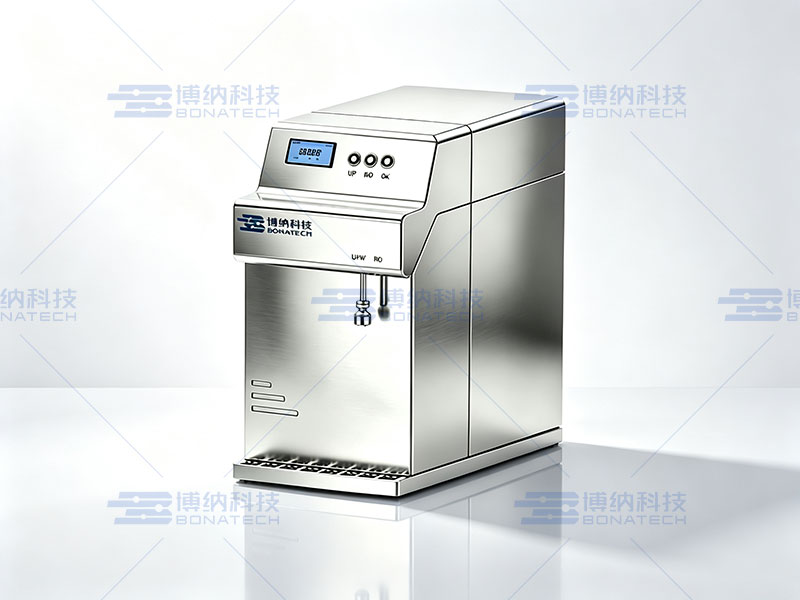
Laboratory Ultrapure Water System

For universities, research institutes, QC centers, and biopharma labs, providing stable Type I ultrapure and Type II pure water. Convenient dispensing and real-time water-quality visibility meet needs from routine analysis to precision instrument injection.

Recommended Models

RO Permeate Specifications

  • Rated Output Rate30 L/h
  • Dispensing Rate (Full Tank)1.5–2 L/min
  • Salt Rejection96–99%
  • Bacteria Removal Rate>99.9%

Ultrapure Water Specifications

  • Resistivity (25°C)18.25 MΩ·cm
  • Heavy Metal Ions<0.01 ppb
  • Total Organic Carbon (TOC)<3 ppb
  • Bacteria Count<1 cfu/mL
  • Particulates (>0.1 μm)<1 particles/mL
  • Pyrogen (Endotoxin)<0.001 EU/mL
  • RNase<1 pg/mL
  • DNase<5 pg/mL

Get a Custom Quote & More Selection Options

Share your water-quality requirements and usage volume, and a BonaTech engineer will tailor a configuration to your lab and provide a quote.

FAQ

Frequently Asked Questions About Laboratory Pure Water Systems

Frequently asked questions about pure/ultrapure water selection, water-quality indicators, feed-water conditions, and daily maintenance

What is the difference between pure water and ultrapure water, and how should I choose?

Pure water (RO permeate) undergoes primary purification such as reverse osmosis, with ion removal of 96%–99%, suitable for glassware rinsing, general physical/chemical testing, and equipment feed. Ultrapure water is further purified by UV photo-oxidation, pyrogen-removal UF, and terminal microfiltration, reaching resistivity 18.25 MΩ·cm (25°C), TOC <3 ppb, and bacteria <1 cfu/mL—ideal for analytical detection such as HPLC/mass spectrometry, molecular biology, and cell culture. BonaTech pure water systems deliver both from one unit, so either grade can be drawn as needed.

What does 18.25 MΩ·cm mean, and why does resistivity drop after ultrapure water is left standing?

Resistivity reflects the amount of residual ions in water. 18.25 MΩ·cm (25°C) is the theoretical limit of pure water, approaching zero ionic residue. Ultrapure water readily dissolves carbon dioxide from air and leaches substances from containers, so its resistivity drops quickly with standing time—use it immediately after dispensing. The system's online resistivity monitoring shows water-quality status in real time.

What does "dual-output (pure and ultrapure water from one unit)" mean, and can both be drawn at the same time?

Dual-output means a single system provides two water streams at once: pure water from RO, and ultrapure water further purified by UV photo-oxidation, pyrogen-removal UF, and terminal microfiltration—each with its own dispensing port, so both can be drawn simultaneously. Rated output is 30 L/h, with instant dispensing of 1.5–2 L/min when the tank is full, meeting multi-point lab demand.

Can the system handle high-hardness, high-silica tap water directly?

Yes, directly. The front end uses two-stage pretreatment—a softening cartridge and a silica-removal cartridge—delivering effluent hardness ≤0.03 mmol/L and soluble silica ≤0.01 ppm before entering RO, which protects product-water quality while extending the life of the RO membrane and downstream consumables. Areas with particularly poor feed water can add pretreatment capacity.

Which experiments are most sensitive to TOC, pyrogens, and RNase/DNase?

TOC (total organic carbon) affects the baseline and background of high-sensitivity analyses such as HPLC and mass spectrometry. Pyrogens (endotoxins) affect cell culture, animal studies, and injectable-related research. Residual RNase/DNase degrades RNA/DNA samples and is a key control item in molecular biology (PCR, sequencing, nucleic-acid extraction). Our ultrapure water reaches TOC <3 ppb, pyrogen <0.001 EU/mL, RNase <1 pg/mL, and DNase <5 pg/mL, covering all the above applications.

Is daily maintenance complicated, and how often should consumables be replaced?

Daily maintenance is simple: the system monitors resistivity and TOC online, so consumable status is always clear. The softening cartridge, silica-removal cartridge, RO membrane, UV lamp, UF module, and terminal microfilter are all modular and plug-and-play—no special tools required. Replacement intervals depend on feed-water quality and usage; replace when due or when indicators are abnormal. BonaTech provides long-term consumable supply and periodic inspection services.

Match the Right Pure Water System to Your Application

Submit your water-quality requirements, usage volume, and industry, and a BonaTech engineer will provide a selection plan and quote.

Contact Us →